


Kinds of energy and how it changes


 About this lesson
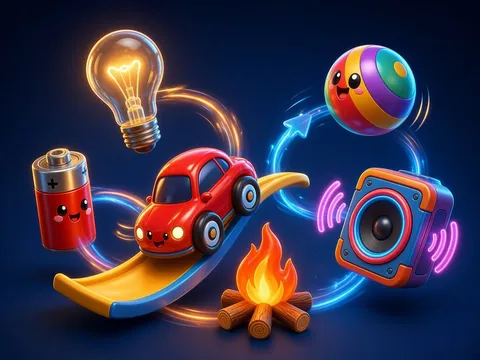
Energy is the ability to do work and make things change: you need energy to move, heat, light or sound something. The main kinds are: kinetic energy, the energy of moving things (a running child, flowing water, wind); potential energy, stored in raised or stretched things (a rock on a hill, a stretched rubber band); thermal (heat) energy in hot things (a fire, a kettle); light energy (the Sun, a lamp); sound energy (a bell, a speaker); electrical energy (electric current, a battery); and chemical energy, stored in food, fuel and batteries. Energy is not created from nothing and does not vanish; it only changes from one kind to another. In a lamp, electrical energy becomes light and heat; a ball rolling down a slope turns potential energy into kinetic energy; we turn the chemical energy in food into movement and warmth; in a fire the chemical energy of wood becomes heat and light. During a change some energy usually spreads into the surroundings as heat, which is why a working lamp or phone gets warm. To save energy, switch off lights you do not need and do not leave devices running for nothing.
 What the book shows

In grade 5 Natural Science covers the human body and health, the diversity of living things, substances and their properties, energy, force and motion, and the environment. Read the topic in the textbook, do simple experiments with an adult watching, and record what you observe in your notebook.
Textbook link:
This is not the textbook’s text but a short description of the topic. Check the exact page in your own textbook.
 The lesson step by step
- 1
Warm-up5 min
Lamp, ball, fire: what do they share?
- 2
New topic10 min
What energy is.
- 3
Practice10 min
Kinds of energy.
- 4
Game10 min
Energy changes.
- 5
Wrap-up5 min
Drawing an energy chain.
 Let’s understand
For the student Simple language
| Device or event | Which energy → which |
|---|---|
| lamp | electrical → light + heat |
| speaker | electrical → sound |
| ball down a slope | potential → kinetic |
| campfire | chemical → heat + light |
 For the parent
How to help
- Find 5 electrical devices at home together and say what each turns electrical energy into, then switch off any lights you do not need.
 For the teacher
 Lesson goals
- Know that energy is the ability to do work, name and give examples of the main kinds of energy, and explain with a diagram how energy changes from one kind to another.
How to teach it
- Observation, simple experiments, building models, tables and diagrams, mini-research
 Differentiation
- Weaker pupils work from pictures and diagrams; stronger pupils plan their own experiment and draw conclusions
 Questions for the class
- How does energy change from one kind to another?
 How to check
The pupil names kinds of energy with examples, shows energy chains in diagrams and gives ways to save energy.
 Scientific Scientific language
A battery
It stores chemical energy that becomes electrical energy when connected.
The Sun is the main source
Plants turn sunlight into the chemical energy of food, and we eat that food.
Self-study
Step by step
- I said what energy is.
- I named 7 kinds.
- I gave examples of changes.
- I gave ways to save energy.
Going deeper
 Scientific language: for older students, parents and teachers.
Energy is measured in joules (J); food labels often show it in kilocalories too.
 Play and check
Which kind of energy is it?
 How to write it down
- Draw the energy chain when you ride a bike: food → body → pedals → wheels.
- Write a conversion table for 5 devices.
How the classwork looks in the notebook
Sample: the date and heading follow this country’s notebook rules.
 Watch out: common mistakes
 Where it helps in life
- Renewable energy sources
 At home
Core
- Record at least 6 kinds of energy you use in one day.
Extra ⭐
- Make a small energy-saving poster for your family.
How to do it
- Read the topic in the textbook.
- Copy the key words and diagram into your notebook, then make one simple observation and record it.
Answers for parents
Bike chain: chemical energy in food → kinetic energy of muscles → kinetic energy of pedals and wheels; some becomes heat (you warm up).
Step-by-step homework solution — Show the solution (try it yourself first)
Think
- Why does a phone get warm after long use? The battery’s chemical energy becomes electrical energy, then light and sound, but some is given off as heat. The energy is not lost; part of it just becomes heat, which we did not want.
How the homework looks in the notebook
Sample: the date and heading follow this country’s notebook rules.

 About cookies