


The state of Manna


 About this lesson
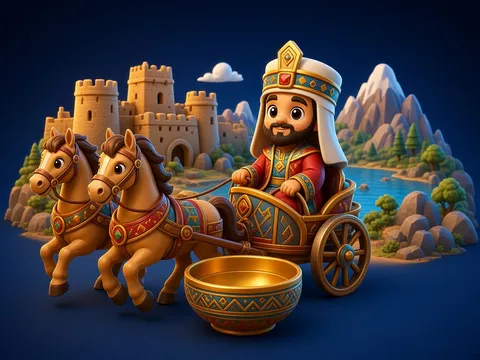
Manna was one of the first strong, centralised states on Azerbaijani lands. It arose in the 9th century BC south and south-east of Lake Urmia, with its capital at Izirtu. Most of what we know comes from the cuneiform texts of neighbouring Assyria and Urartu. Its well-known rulers were Irandzu, his son Ullusunu, and Akhsheri. Manna lay between two powerful neighbours — Assyria to the south-west and Urartu to the north-west — both of which wanted its rich lands. Manna’s rulers sometimes allied with Assyria against Urartu and sometimes manoeuvred to keep their independence. Under Ullusunu Manna grew strong again, and under Akhsheri it reached its greatest extent. A council of elders worked alongside the ruler. The economy rested on farming, herding and especially horse breeding — Mannaean horses were famous abroad. Crafts were highly developed: metalwork, pottery and jewellery. The gold bowl with mythological scenes found at Hasanlu hill and the Ziwiye treasure show this rich culture. At the end of the 7th century BC Manna weakened, and early in the 6th century BC it became part of Media.
 What the book shows

In grade 6 the History of Azerbaijan course starts with key historical ideas and units of time, then covers primitive society, the first states, Manna, Atropatene and Albania, the rise of feudal relations and the Sasanian period. Read the topic in the textbook, look at the maps and pictures, and put the dates on a timeline.
Textbook link:
This is not the textbook’s text but a short description of the topic. Check the exact page in your own textbook.
 The lesson step by step
- 1
Warm-up5 min
A fortress and a chariot by a lake.
- 2
New topic10 min
Origin, territory, capital.
- 3
Practice10 min
Rulers and neighbours.
- 4
Game10 min
Economy and culture.
- 5
Wrap-up5 min
Cause and effect.
 Let’s understand
For the student Simple language
| Question | Answer |
|---|---|
| When? | 9th century – early 6th century BC |
| Where? | south and south-east of Lake Urmia |
| Capital | Izirtu |
| Rulers | Irandzu, Ullusunu, Akhsheri |
| Neighbours | Assyria, Urartu |
| End | became part of Media |
 For the parent
How to help
- Look up a picture of the Hasanlu gold bowl together and discuss what its images might show.
 For the teacher
 Lesson goals
- Know when and where Manna arose, name its capital and well-known rulers, explain its relations with Assyria and Urartu, and describe its economy and culture.
How to teach it
- Working with sources and maps, timelines, discussion, mini-project
 Differentiation
- Weaker pupils work with key dates and pictures; stronger pupils compare sources and write their own conclusion
 Questions for the class
- How can a smaller state stay independent between two powerful neighbours?
 How to check
The pupil knows Manna’s place, time, capital and rulers, and explains its relations with neighbours and its culture.
 Scientific Scientific language
Gold
Gold does not rust, so ancient gold objects stay shiny thousands of years later.
Horses
In the ancient world horses were very valuable for both war chariots and trade.
Self-study
Step by step
- I know Manna’s place and time.
- I named the rulers.
- I explained relations with neighbours.
- I described its economy and culture.
Going deeper
 Scientific language: for older students, parents and teachers.
The Hasanlu gold bowl was found during excavations in 1958 and is now kept in a museum in Tehran.
 Play and check
True or false about Manna?
 How to write it down
- Make a who/when/where table on Manna.
- Show its relations with Assyria and Urartu in a diagram.
- List Manna’s economic activities and crafts.
How the classwork looks in the notebook
Sample: the date and heading follow this country’s notebook rules.
 Watch out: common mistakes
 Where it helps in life
- Azerbaijan in the 7th–4th centuries BC
 At home
Core
- Write a letter from a Mannaean ruler to a neighbouring country: what do you offer, what worries you?
Extra ⭐
- Mark Manna, Assyria and Urartu on an outline map.
How to do it
- Put the dates on a timeline.
- Retell the topic to a grown-up.
Answers for parents
Table: who — Irandzu, Ullusunu, Akhsheri; when — 9th to early 6th century BC; where — south of Lake Urmia, capital Izirtu. Economy: farming, herding, horse breeding; crafts: metalwork, pottery, jewellery.
Step-by-step homework solution — Show the solution (try it yourself first)
Let’s find the cause
- Why did Manna’s rulers sometimes ally with Assyria? Because Urartu threatened from the north; joining one strong neighbour helped resist the other. But these alliances were temporary — the real aim was to stay independent.
How the homework looks in the notebook
Sample: the date and heading follow this country’s notebook rules.
 About cookies