


The cradle of European culture: ancient Greece


 About this lesson
Ancient Greece lay in the south of the Balkan peninsula, on the islands of the Aegean Sea and along the coast of Asia Minor. The land was mountainous with little farmland, so the Greeks turned to seafaring, trade and crafts, and founded colonies on the shores of the Mediterranean and the Black Sea. Mountains split the country into separate valleys, so Greece was not one state but many city-states, each called a polis. The best known were Athens and Sparta. In Athens in the early 6th century BC Solon carried out reforms: enslaving people for debt was banned, and ordinary citizens as well as the rich began to take part in government. Later Athens developed democracy, “rule by the people”: important decisions were taken by the assembly of citizens. But women, slaves and people from other cities were not counted as citizens. Democracy flourished under Pericles (5th century BC), when the Parthenon temple was built on the Athenian Acropolis. In Sparta everything served the army: boys were taken from their families at the age of seven for harsh military training, Spartans were meant to be nothing but soldiers, and the land was worked by dependent people called helots. In the 5th century BC the Greeks fought off invasions by the Achaemenid empire. In 490 BC the Athenians defeated the Persian army on the plain of Marathon. Legend says a soldier ran to Athens without stopping to bring news of the victory and died after delivering it; the modern marathon race honours this legend. The Greeks worshipped many gods, chief among them Zeus. In his honour, from 776 BC, athletic games were held at Olympia every four years, and wars stopped while the games went on. The Greeks achieved great things in theatre, sculpture, architecture, philosophy and science; the philosophers Socrates, Plato and Aristotle and the historian Herodotus all lived in Greece. In the 4th century BC Macedonia, to the north, grew strong. Alexander the Great became king in 336 BC, defeated the Achaemenid empire, conquered a vast area from Egypt to India, and died in Babylon in 323 BC. His teacher had been Aristotle. After Alexander’s campaigns, the Greek language and culture spread widely across the East.
 What the book shows

In grade 6 the World History course covers the civilisations of the ancient East and West: Egypt, Mesopotamia, Iran, Great Turkestan, China, Greece and Rome. Read the topic in the textbook, look at the map, put the dates on a timeline and compare the civilisations with each other.
Textbook link:
This is not the textbook’s text but a short description of the topic. Check the exact page in your own textbook.
 The lesson step by step
- 1
Warm-up5 min
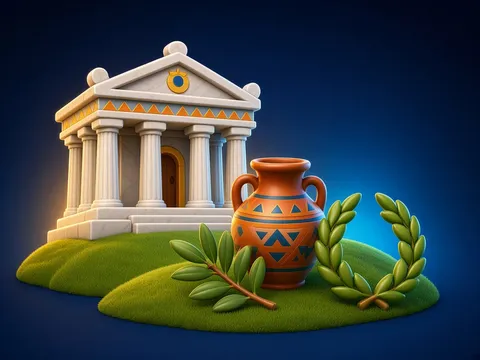
A white marble temple on a hill.
- 2
New topic10 min
City-states: Athens and Sparta.
- 3
Practice10 min
Marathon and Olympia.
- 4
Game10 min
Greek culture and Alexander.
- 5
Wrap-up5 min
Reading a pottery vote.
 Let’s understand
For the student Simple language
| Question | Athens | Sparta |
|---|---|---|
| who ruled | the citizens’ assembly (democracy) | two kings and a council of elders |
| upbringing | reading, music, sport | harsh military training |
| economy | trade, crafts, seafaring | the labour of helots |
 For the parent
How to help
- Hold a family “assembly” and vote on your weekend plan. Then discuss who could not vote in Athenian democracy.
 For the teacher
 Lesson goals
- Describe the Greek city-states, compare Athenian democracy with the Spartan system, and explain the Greek-Persian wars, the Olympic Games, Greek culture and the campaigns of Alexander the Great.
How to teach it
- Working with sources and maps, timelines, comparison tables, discussion
 Differentiation
- Weaker pupils work with key dates, names and pictures; stronger pupils compare civilisations and write their own conclusion
 Questions for the class
- Would you rather have lived in Athens or Sparta, and why?
 How to check
The pupil describes a polis, compares Athens and Sparta, and explains Marathon, the Olympic Games, Greek culture and Alexander’s campaigns.
 Scientific Scientific language
The Olympic flame
The torch for the modern Olympics is still lit by the Sun’s rays at ancient Olympia in Greece.
Greek in our words
Many words, such as “democracy”, “history”, “geography”, “mathematics” and “theatre”, come from Greek.
Self-study
Step by step
- I know what a polis is.
- I compared Athens and Sparta.
- I explained Marathon and the Olympic Games.
- I showed Alexander’s campaigns.
Going deeper
 Scientific language: for older students, parents and teachers.
The distance of the marathon was not fixed in ancient times; today’s 42.195 km was settled in the early 20th century.
 Play and check
Athens or Sparta?
 How to write it down
- Compare Athens and Sparta on 4 points.
- Mark 776, 490, 336 and 323 BC on a timeline.
- Write 5 achievements of Greek culture.
How the classwork looks in the notebook
Sample: the date and heading follow this country’s notebook rules.
 Watch out: common mistakes
 Where it helps in life
- The makers of the first republic
 At home
Core
- Write two short texts comparing a day in the life of a Spartan teenager and an Athenian one.
Extra ⭐
- Choose one Olympic sport: what was it like then, and what is it like now?
How to do it
- Put the dates on a timeline.
- Retell the topic to a grown-up.
Answers for parents
In a democracy decisions are taken by the citizens, not by one man; the idea later spread across Europe and the world. In Athens, though, only free men had citizens’ rights.
Step-by-step homework solution — Show the solution (try it yourself first)
Working with a source
- In Athens citizens voted by scratching names on pieces of broken pottery; the man named most often was sent away from the city for 10 years. What does this show? Citizens could vote out a man who might grow too powerful and dangerous, as one way of protecting democracy.
How the homework looks in the notebook
Sample: the date and heading follow this country’s notebook rules.

 About cookies