


Up, down, right, left


 About this lesson
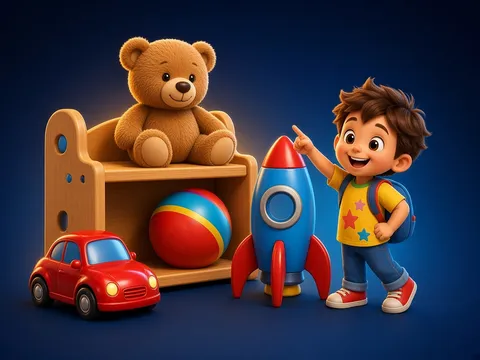
To say where something is we need position words. Right and left come from our own hands.
 What the book shows

The textbook usually gives a picture example, a counting or comparing task and a short check. Talk about the picture first, then try the tasks with real objects.
Textbook link:
This is not the textbook’s text but a short description of the topic. Check the exact page in your own textbook.
 The lesson step by step
- 1
Body game5 min
Right hand, left foot, above your head.
- 2
The shelf10 min
We talk about the picture.
- 3
Dictation10 min
The teacher says, children draw.
- 4
Hide and find10 min
Pairs give each other directions.
- 5
Wrap-up5 min
How do we remember right and left?
 Let’s understand
For the student Simple language
Look at the shelf! The bear is at the top, the ball is at the bottom. The car is on the left, the rocket on the right.
More words
between (in the middle of two things), in front of, behind, on, under.
 For the parent
How to help
- Play hide-and-find: “The toy is under the chair.”
- On walks ask “Do we turn right or left now?”
- Put a band on the right wrist as a reminder.
 For the teacher
 Lesson goals
- Putting spatial relations into words.
How to teach it
- Movement games, picture dictation.
 Differentiation
- Struggling pupils: a mark on the right hand.
 Questions for the class
- Why is the facing person’s right our left?
 How to check
The pupil follows 4 of 5 directions correctly.
 Scientific Scientific language
Spatial sense
Spatial relations underpin geometry and map reading. Children first orient by their own body (right hand, left foot), then by objects (to the left of the ball). A person facing us has their right on our left, a tricky point in grade 1.
Self-study
Step by step
- Find your right hand first.
- Look at the thing and say where it is.
- Use a full sentence: “The ball is under the bear.”
Going deeper
 Scientific language: for older students, parents and teachers.
Spatial thinking is closely linked to success in maths: the number line, tables, shapes and graphs all rely on right/left and up/down.
Children first orient relative to themselves, then to objects. Taking another person’s point of view comes later.
 Play and check
Using the shelf picture: top or bottom?
 How to write it down
- Draw a circle in the middle. A triangle to its left, a square to its right.
- A star above the circle and a line below it.
How the classwork looks in the notebook
Sample: the date and heading follow this country’s notebook rules.
 Watch out: common mistakes
 Where it helps in life
- Maps and plans: directions.
- Road safety: look both ways before crossing.
 At home
Core
- Describe your room: what is up, down, right and left?
Challenge ⭐
- Give a parent directions (“2 steps forward, turn right…”) to find a toy.
How to do it
- Check using your own body each time.
- Use full sentences.
Answers for parents
Answers vary. Check that the position words are used correctly.
Step-by-step homework solution — Show the solution (try it yourself first)
Say the place
- Pick a thing and use two words: “The ball is under the table, left of the chair.”
How the homework looks in the notebook
Sample: the date and heading follow this country’s notebook rules.

 About cookies